You are here:Home / Blog / The Difference Between PVC Anti-Static Roll and Sheet
The Difference Between PVC Anti-Static Roll and Sheet
Views: 0 Author: Site Editor Publish Time: 2024-12-12 Origin: Site
Today, we’ll discuss the differences between anti-static PVC floor rolls and sheets, focusing on their production process, color, price, and service life. The general dimensions for rolls are typically 2 meters wide and 20 meters long, while sheets often measure 600mm x 600mm. Their standard thickness is 2mm, but they can also be customized to 2.5mm or 3mm. Let’s start by exploring the production process.
Production Process
PVC Anti-Static Floor Roll
Anti-static PVC floor rolls are semi-hard rolls created by mixing conductive carbon black with polyvinyl chloride (PVC) particles. These are then molded at high temperatures using a hot press. Due to their homogeneous and permeable structure, the conductive network formed by the conductive carbon black is interconnected, ensuring a permanent anti-static effect.
PVC Anti-Static Floor Sheet
In contrast, anti-static PVC floor sheets are produced using polyvinyl chloride resin, shrinkage agents, stabilizers, coupling agents, and conductive materials, which are also hot-pressed. These sheets utilize the conductive network formed at the interfaces between plastic particles to conduct electricity, achieving a similarly permanent anti-static effect.
Surface Patterns
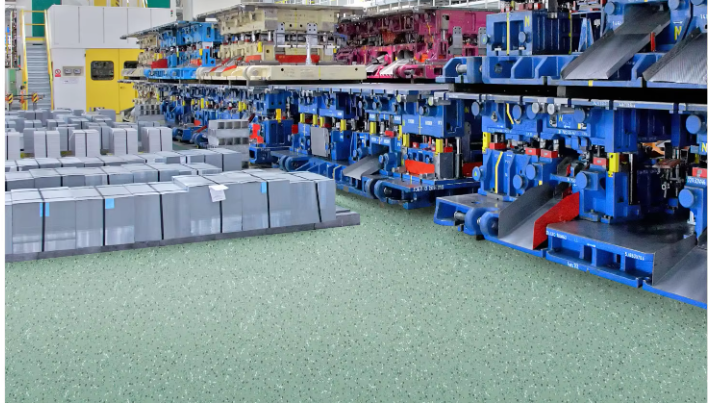
The difference in production techniques results in distinct surface patterns for rolls and sheets, making them visually distinguishable. Rolls generally exhibit a seamless, smooth appearance, while sheets have defined, segmented patterns.
Price Comparison
The price of PVC anti-static floor rolls tends to be higher than that of sheets. This is because rolls involve a more extensive production process and contain a higher proportion of PVC.
Service Life
The PVC content in anti-static PVC floor rolls is significantly higher than in sheets, resulting in better wear resistance. Consequently, rolls have a longer service life compared to sheets.
Installation and Maintenance
Installation: Rolls are generally easier and faster to install than sheets due to their continuous format. This reduces the need for precise alignment and minimizes seams.
Maintenance: Sheets, on the other hand, are more convenient to replace or repair since individual tiles can be removed and substituted without disturbing the surrounding area.
Applications
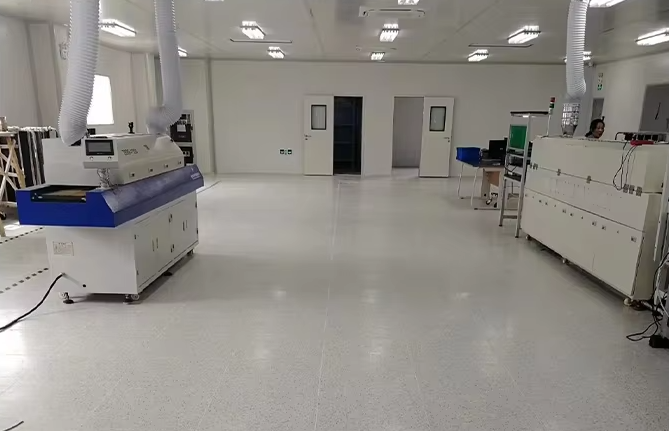
Both PVC anti-static floor rolls and sheets provide permanent anti-static properties and are widely used in environments requiring precision and safety. Common applications include:
Electronics and Microelectronics Industries
Telecommunications Facilities
Network Floors
Clean Rooms
Computer Rooms
Locations Housing Precision Instruments and Equipment
Conclusion
PVC anti-static floor rolls and sheets each have their own unique advantages. Rolls offer better durability, simpler installation, and longer service life, while sheets are more cost-effective and easier to maintain. Both materials are essential in environments where anti-static properties are critical, ensuring the safe operation of sensitive equipment and maintaining a controlled environment. Choosing between them depends on specific project requirements and priorities, such as budget, ease of installation, and long-term maintenance needs.

 English
 العربية
 Français
 Русский
 Español
 Português
 Deutsch
 italiano
 日本語
日本語 한국어
한국어 Nederlands
 Tiếng Việt
 ไทย
ไทย Polski
 Türkçe
 አማርኛ
አማርኛ Bahasa Melayu
 தமிழ்
தமிழ் Filipino
 Bahasa Indonesia
 magyar
 Română
 Монгол
 қазақ
қазақ Српски
 हिन्दी
 فارسی
فارسی Kiswahili
 Slovenčina
 Slovenščina
 Svenska
 українська
 Ελληνικά
 Suomi
Suomi Հայերեն
 עברית
עברית اردو
اردو Shqip
Shqip বাংলা
বাংলা Hrvatski
 Afrikaans
 Māori
Māori සිංහල
සිංහල Oʻzbekcha
 latviešu
 Беларуская мова
 Bosanski
 Български
 ქართული
 Lietuvių
 Malti
Malti