You are here:Home / Blog / Why ES Hot-Rolled Nonwoven Fabric Is So Popular & Its Critical Role in the Medical Industry
Why ES Hot-Rolled Nonwoven Fabric Is So Popular & Its Critical Role in the Medical Industry
Views: 0 Author: Site Editor Publish Time: 2026-01-20 Origin: Site
ES hot-rolled nonwoven fabric has emerged as a star material in the nonwoven industry, thanks to its unique manufacturing process, superior performance, and versatile applications. It is especially irreplaceable in the medical field, where safety, comfort, and functionality are paramount. This article explains the core reasons for its popularity and details its key roles in medical applications.
I. Core Reasons for the Popularity of ES Hot-Rolled Nonwoven Fabric
ES hot-rolled nonwoven fabric stands out from traditional woven fabrics and ordinary nonwovens due to its innovative production method and outstanding performance advantages, which drive its widespread adoption across industries.
1. Breakthrough Production Process: Efficient, Cost-Effective & Eco-Friendly
Unlike traditional woven fabrics that require spinning, weaving, and dyeing processes, ES hot-rolled nonwoven fabric is produced by physically bonding ES bicomponent fibers via hot rolling—no chemical adhesives are needed. This process has three key advantages:
Short process flow & high efficiency: It skips complex textile procedures, enabling fast production speed and large output, which reduces manufacturing costs significantly.
Abundant raw materials: ES fibers (ethylene-propylene side-by-side bicomponent fibers) are derived from petroleum-based polymers, with stable supply and customizable formulas.
Better environmental performance: Compared to plastic products, ES hot-rolled nonwoven fabric has a lower carbon footprint during production. While its natural degradation rate is slower than that of fully biodegradable materials, it is more eco-friendly than single-use plastic bags and can be recycled for secondary processing.
2. Superior Performance: Softness, Breathability & Versatility
ES hot-rolled nonwoven fabric inherits the core advantages of ES fibers and the hot-rolled bonding process, making it far more functional than ordinary nonwovens:
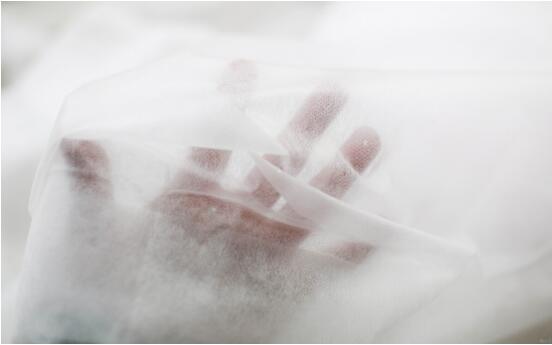
Ultra-soft & skin-friendly: The bicomponent structure of ES fibers creates a naturally crimped texture after hot rolling, giving the fabric a cotton-like softness that avoids irritation even with long-term skin contact.
Excellent breathability: The hot-rolled bonding process forms a porous, interconnected structure that allows air circulation while blocking dust and particles—balancing comfort and basic barrier properties.
Lightweight & flat: It has a uniform thickness and smooth surface, with no loose threads or wrinkles, making it suitable for high-precision composite processing (e.g., combining with meltblown fabric for masks).
Cost-effective: Compared to high-end nonwovens like spunlace fabric, ES hot-rolled nonwoven fabric offers comparable softness at a lower price, making it a cost-efficient choice for mass production.
3. Wide Application Range: From Daily Life to Industrial Fields
Its balanced performance and low cost make ES hot-rolled nonwoven fabric a versatile material:
Hygiene products: Baby diaper top sheets, sanitary napkin surface layers, and adult incontinence product linings.
Industrial applications: Filter material substrates, shock absorption padding, and sound insulation materials.
Medical field: The most critical application scenario, where it is used to make high-performance medical supplies such as masks, surgical gowns, and sterile packaging.
II. Critical Role of ES Hot-Rolled Nonwoven Fabric in the Medical Industry
Against the backdrop of global health demands, ES hot-rolled nonwoven fabric has become an indispensable material in the medical sector, with its core value concentrated in mask production and other medical supplies.
1. Core Component of High-Comfort Medical Masks
Medical masks (especially surgical masks and KN95/N95 respirators) adopt a multi-layer structure, and ES hot-rolled nonwoven fabric plays a unique role in optimizing wearing experience—complementing the filtration function of meltblown fabric.
Key Functions in Mask Structure
Mask Layer Combination
ES Hot-Rolled Fabric Position
Core Functions
ES Hot-Rolled + Meltblown + Spunbond
Inner layer (skin-contacting)
1. Provides softness to reduce facial friction and irritation during long-term wear 2. Enhances breathability to prevent stuffiness 3. Absorbs moisture from exhalation to keep the mask dry
Spunbond + Meltblown + ES Hot-Rolled
Outer layer
1. Serves as a lightweight barrier against dust and droplets 2. Maintains a flat appearance without deformation 3. Improves the mask’s tactile feel
Performance Complementarity with Other Mask Materials
vs. Meltblown Fabric: Meltblown fabric is the "heart" of the mask, responsible for electrostatic adsorption of bacteria and particles. ES hot-rolled fabric lacks strong electrostatic properties but improves comfort—resolving the problem of ordinary meltblown-spunbond composite masks being stiff and stuffy.
vs. Spunbond Fabric: Spunbond fabric has high strength and good barrier properties but is relatively stiff. ES hot-rolled fabric is softer and more breathable, making it the preferred choice for the mask’s inner skin-contacting layer.
2. Applications in Other Medical Supplies
Beyond masks, ES hot-rolled nonwoven fabric is widely used in other medical scenarios due to its softness, hygiene, and barrier properties:
Surgical Gowns & Isolation Gowns: Used as the inner lining to improve wearing comfort for medical staff, while the outer layer uses high-strength spunbond fabric for liquid resistance.
Sterile Packaging Materials: Medical-grade ES hot-rolled fabric can be processed into sterile packaging for surgical instruments and dressings, as it is lint-free and does not shed fibers that could contaminate sterile environments.
Medical Dressings & Bandages: As a wound contact layer for minor dressings, it provides a soft, breathable surface that promotes wound healing without sticking to the skin.
Disposable Medical Bed Linens: Used for hospital bed sheets, pillowcases, and mattress covers—offering single-use hygiene, softness, and water repellency (after hydrophobic treatment).
3. Compliance with Medical-Grade Standards
Medical-grade ES hot-rolled nonwoven fabric must meet strict industry standards to ensure safety:
Antibacterial & lint-free properties: It can be added with antibacterial masterbatches during production to inhibit the growth of bacteria, and its hot-rolled bonding process prevents fiber shedding—critical for sterile medical environments.
Low VOC emission: It complies with medical device regulations (e.g., FDA standards in the U.S.) and does not release harmful substances that could affect patients or medical staff.
Biocompatibility: It passes skin irritation tests, ensuring no allergic reactions even for users with sensitive skin.
III. Conclusion
ES hot-rolled nonwoven fabric’s popularity stems from its efficient production process, balanced performance, and cost-effectiveness. In the medical industry, it is not only a key material for improving mask comfort but also a reliable choice for surgical gowns, sterile packaging, and dressings—filling the gap between functionality and comfort in medical supplies.
As medical technology advances and global health awareness grows, the demand for high-performance ES hot-rolled nonwoven fabric will continue to rise, especially for products that require both safety and user comfort.
Would you like me to help you create a medical-grade ES hot-rolled nonwoven fabric product specification sheet that highlights key parameters like basis weight, softness rating, and compliance standards?

 English
 العربية
 Français
 Русский
 Español
 Português
 Deutsch
 italiano
 日本語
日本語 한국어
한국어 Nederlands
 Tiếng Việt
 ไทย
ไทย Polski
 Türkçe
 አማርኛ
አማርኛ Bahasa Melayu
 தமிழ்
தமிழ் Filipino
 Bahasa Indonesia
 magyar
 Română
 Монгол
 қазақ
қазақ Српски
 हिन्दी
 فارسی
فارسی Kiswahili
 Slovenčina
 Slovenščina
 Svenska
 українська
 Ελληνικά
 Suomi
Suomi Հայերեն
 עברית
עברית اردو
اردو Shqip
Shqip বাংলা
বাংলা Hrvatski
 Afrikaans
 Māori
Māori සිංහල
සිංහල Oʻzbekcha
 latviešu
 Беларуская мова
 Bosanski
 Български
 ქართული
 Lietuvių
 Malti
Malti