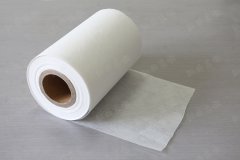
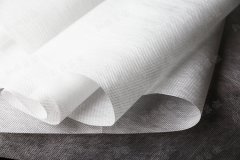
Hot-air nonwoven fabric and spunbond nonwoven fabric are two widely used materials in diaper production. The top sheet of a diaper is a critical component as it comes into direct contact with babies’ delicate skin. Therefore, selecting the right top sheet material is essential for ensuring comfort and safety. Today, we’ll break down the key differences between these two common nonwoven fabrics.
I. Production Principles
1. Hot-Air Nonwoven Fabric
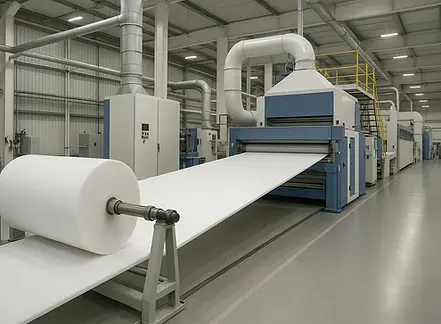
Hot-air nonwoven fabric falls under the category of thermally bonded (hot-air bonded) nonwovens. Its production process starts with short fibers that undergo carding to form a fiber web. Next, hot air from a drying device penetrates this web, and the heat causes the fibers to bond together, resulting in the final nonwoven fabric.
2. Spunbond Nonwoven Fabric
The production of spunbond nonwoven fabric begins with polymer chips (its raw material, no pre-made fibers involved). These polymers are extruded and stretched to form continuous filaments, which are then laid into a fiber web. The web is subsequently converted into nonwoven fabric through one or more reinforcement methods: self-adhesion, heat sealing, chemical bonding, or mechanical reinforcement. A key characteristic is that it uses long filaments derived directly from plastic chips.
II. Comparison of Advantages and Disadvantages
| Characteristics | Hot-Air Nonwoven Fabric | Spunbond Nonwoven Fabric |
| Key Advantages | High bulkiness, excellent elasticity, soft touch (skin-friendly), strong warmth retention, good breathability, and superior water permeability. | Outstanding mechanical properties: superior tensile strength, elongation at break, and tear strength. Thin in thickness, produced directly from polymer particles (no fiber pre-processing), and offers good structural stability. |
| Key Disadvantages | Low overall strength, prone to deformation under external force. | Softness and breathability are significantly inferior to hot-air nonwoven fabric; feels relatively stiff to the touch. |
Practical Application Note: Due to their skin-friendly softness and breathability, high-quality diapers typically use hot-air nonwoven fabric for the top sheet. In contrast, spunbond nonwoven fabric—with its excellent strength and stability—is more commonly used in medical and hygiene products that require structural durability (e.g., medical gowns, surgical drapes, and hygiene product outer layers).
III. How to Distinguish Between the Two
1. Sensory Test (Most Direct Method)
Touch the fabric directly: Hot-air nonwoven fabric feels soft, fluffy, and comfortable (similar to cotton), while spunbond nonwoven fabric feels stiff and firm (with a slight plastic-like texture).
2. Tensile Test
Gently pull the fabric: When stretched, hot-air nonwoven fabric easily frays or pulls out loose fibers. In contrast, spunbond nonwoven fabric is hard to tear, and its continuous filaments do not easily pull out in strands.
IV. Uses of Hot-Air Nonwoven Fabric & Its Difference from Needle-Punched Cotton
1. Common Uses of Hot-Air Nonwoven Fabric
The applications of hot-air nonwoven fabric vary by its density:
Low to medium density: Baby diapers, adult incontinence pads, feminine hygiene products, napkins, bath towels, and disposable tablecloths (leveraging its softness and water permeability).
Thicker varieties: Winter clothing linings, bedding, baby sleeping bags, mattresses, and sofa cushions (utilizing its bulkiness, warmth retention, and elasticity).
High density (hot-melt adhesive type): Filter materials, sound insulation materials, and shock-absorbing materials (benefiting from its structural tightness and bonding stability).
2. Key Differences Between Hot-Air Nonwoven Fabric (Hot-Air Cotton) and Needle-Punched Cotton
a. Raw Materials & Production Process
Hot-Air Cotton: Made from ES fibers (ethylene-propylene side-by-side fibers). Compared to polyester fibers, ES fibers are smoother and softer, enabling the production of low-basis-weight (lightweight) fiber webs. It is commonly used in baby diapers, hygiene products, and foldable masks due to its lightness, thinness, and breathability.
Needle-Punched Cotton: Made from polyester fibers. It has a higher basis weight (heavier) and density, making it suitable for clothing linings, heating pads, and irregularly shaped masks. Its high density allows for high-temperature molding.
b. Manufacturing Technology & Visual Characteristics
Hot-Air Cotton: Produced by laying fiber webs in a mesh drying oven, where hot air bonds the fibers. Visually, it appears smooth and even; close inspection reveals multiple layers of fiber web bonded together (no visible holes).
Needle-Punched Cotton: Manufactured via a needle-punching process—synthetic fiber webs are pierced by countless needles on multiple needle plates. Close inspection shows countless tiny needle holes (hence the name "needle-punched cotton").

 English
 العربية
 Français
 Русский
 Español
 Português
 Deutsch
 italiano
 日本語
日本語 한국어
한국어 Nederlands
 Tiếng Việt
 ไทย
ไทย Polski
 Türkçe
 አማርኛ
አማርኛ Bahasa Melayu
 தமிழ்
தமிழ் Filipino
 Bahasa Indonesia
 magyar
 Română
 Монгол
 қазақ
қазақ Српски
 हिन्दी
 فارسی
فارسی Kiswahili
 Slovenčina
 Slovenščina
 Svenska
 українська
 Ελληνικά
 Suomi
Suomi Հայերեն
 עברית
עברית اردو
اردو Shqip
Shqip বাংলা
বাংলা Hrvatski
 Afrikaans
 Māori
Māori සිංහල
සිංහල Oʻzbekcha
 latviešu
 Беларуская мова
 Bosanski
 Български
 ქართული
 Lietuvių
 Malti
Malti


